Showing posts with label antpitta. Show all posts

11 September 2015

PITTASOMA...Ecuador (11th September)


OK, so I have been a bit slack on the blog lately, and I apologise for that. I have had plenty to blog about, what with recent (July-September) tours for Tropical Birding in Costa Rica and Sulawesi and Halmahera, all of which will follow soon. However...

So what got me back blogging again; it needed something special to wrench me out of my social media slumber, and boy was it something special. I have resided in Quito, Ecuador, in the Andes of South America for the past ten years. In that time I have built a healthy, though not outstanding Ecuador list of around 1300 species (I do not keep a strict count on it to be honest, unlike some other manic birders in the country-you know who you are Dusan, Roger, Jonas etc. !!!) I am not an avid Ecuador bird lister, but always enjoy seeing something new in this "dream birding" home that I find myself in. There are few countries like Ecuador, where lifers still creep in this many years after moving in, but that is what happens when you live in the north Andean countries of the "Bird Continent" of South America; the diversity is so high, it is barely fathomable. There are simply too many birds tucked away in this country to pick up in a short time, it takes a lifetime, as people like Robert Ridgely and others would attest to, that have spent the best part of their lives here.

Back to today then; for some years there have been a number of "Holy Grail Birds" in Ecuador that have been spoken of in hushed tones for years, and mean envious glances have been thrown towards the birders who could claim to have seen them. I am thinking of birds like Giant Antpitta, Jocotoco Antpitta, Peruvian Antpitta and Banded Ground-Cuckoo especially, which could rightly claim "grail status", but have in recent years been "humbled", with feeding sites bringing them into the the realms of the possible for surprisingly many birders. And I sincerely applaud those that have put the effort into achieving this, and have made these birds remarkably available to many birders - people like Angel Paz (with Giant Antpitta near Mindo), Nicole Buttner (with the ground-cuckoo at the wonderful Un Poco del Choco reserve), the staff at Tapichalaca reserve for the amazing Jocotoco Antpitta, and Cabanas San Isidro for the Peruvian number. I fully support the feeding of birds, which makes them suddenly available and loved by more people; that can only be good for the spread of the joy of birding, and the ultimate conservation objectives for the species, with heightened interest in them.
So it appeared to some from afar anyway, perhaps that all the most wanted Ecuadorian birds had been "unblocked", and become shockingly gettable after years in the proverbial wilderness, with few being able to claim them on their own life lists. However, those who dwell in Ecuador could see one species that had escaped the spate of feeding that has slowly spread through the country (and beyond into Colombia, Peru, and even Brazil now), to the delight of world birders and photographers alike. This bird has been known to many Ecuador-based birders for years, but few can claim many or any encounters with the species, even after years of roaming the Andes in search of birds. Rumors abound about this bird; it sings in the dry season, sings in the wet season but only late in the morning, when everything else is quiet; it is best on sunny days, when activity generally is slow for everything else; it hardly ever calls; it is best looked for at antswarms, though few could have claimed to back this up with personal sightings, and so on. In short, sightings were few enough that few birders can claim expertise with the species; the sample size was simply too small. With the "discovery" and development of Mashpi as a relatively "new" birding destination in the last decade increased the contact with this species, these rich, humid forests, which were relatively poorly known (compared with say, nearby Mindo that is), until fairly recently. Since then, the influx of birders and ornithologists, eagerly lapping up the chances to see good numbers of scarce species like Glistening-green Tanager and Moss-backed Tanager, and the rare Choco Vireo, among others; led to further sightings of this avian pimpernel, and people like me started to believe a day would come, where maybe, just maybe, I might be able to catch site of one. Of course, I had tried at other places for the bird, for example in the dense, difficult to bird jungles of Playa de Oro, in Esmeraldas province of Ecuador, which until now, could arguably have represented the best site for the species. However, in spite of many visits there, by many birders, few among them walked away with an encounter with this bird. To add to its mystery and allure, the species was originally thought of as an antpitta, a shy, elusive family of ground-dwelling birds that hold special appeal among birders chasing a big world or South American list, The family has kudos, and to have a rare beast among them, with few sightings just gave this bird even more appeal. Then, recently, genetic evidence suggested the two species within this genus (the other being a rarer, though more regularly seen species in Central America), were, in fact, NOT antpittas after all, but may be Gnateaters instead. This might appear to have made the bird less appealing, but far from it, this just added an air of mystery to it, and oddity that birders like me eat up in spades. Of course, the bird I am talking about is the "Pittasoma" of Ecuador and Colombia (where it only seems to dwell within areas that are still considered too dangerous to travel to), the Rufous-crowned Antpitta. In spite of its recently changed status to a Gnateater, and not an antpitta, the bird's name remains "Rufous-crowned Antpitta" with many in the birding community supporting a name change to "Rufous-crowned Gnatpitta"  that has not yet been adopted, but is widely spoken among birders who have seen it, or have not but can still bare to speak of it.

During a prolonged period of guiding recently in Costa Rica and Indonesia, dating back to July, news reached me that Ecuadorian based birder, conservationist and ornithologist, Alejandro Solano, had managed to track one of these special birds down, and had done the unbelievable; he'd managed to habituate one to come in an feed on worms, much in the manner of the other species spoken of earlier. This was great news, had it not been that I was in the midst of a 12-week guiding period, where I personally, could do nothing about it, but look on with envy! Of course, I had amazing times guiding on all three of those tours; BUT, I always had one idea on what was happening back in my adopted country, with a certain denizen of the forest floor. On reaching back home last week, my attentions, once again, turned to the pittasoma, which yesterday we found out was still around, at least for 85% of the time (a pretty impressive percentage for a bird so rare!) And so, today, I traveled to the site to meet Alejandro, and hope to meet his increasingly famous bird, with fellow Tropical Birding guides Andres Vasquez, Iain Campbell and Nick Athanas. We ALL wanted this bird bad.

On arriving at the site Alejandro seemed calm, and so did we; however underneath the surface, Ia m sure some, if not all, among the Tropical Birders were anything but. We walked through the Cocoa plantations for which the site is growingly famous for (it produces high-end, Artesanal chocolate on site), and entered the pleasant shade, and welcoming gloom, for that is both our regular home, as Tropical Birding guides, and the realm of the pittasoma. We climbed up the trail, and reached the site apparently a little early, according to Alejandro (before 4PM). Within the hour Iain glimpsed an antpitta-like bird fleetingly, which saw tensions visibly raised among the group; Nick, in particular, and perhaps me too, became nervy and instantly focused, our eyes flocking this way and that across the forest floor, in the hope of our quarry. Alejandro worked tirelessly to find the bird that he had so shockingly befriended; then, suddenly his low whistles were answered by some low whistles from the real thing! It was painfully quiet though, and it was not clear if it was "whispering" closeby, or was indeed, frustratingly distant. It answered again, then silence returned to the forest, save for the sounds overhead of fruitcrows and caciques foraging noisily in the canopy. After some time with no further reply, it appeared that it may not be close, or, worse still, the bird had slipped away from us, just when it had appeared so close. And so we walked deeper into the forest, walking offtrail and downslope, hoping, though not knowing that we may be moving closer to our avian quarry. We stood on a steep valley side, while Alejandro tried whistling and calling to the bird again; when suddenly a flurry from Andres stated the bird had appeared dramatically just 15 feet away, but was frustratingly hidden from me behind a large buttress, and it was clear Andres was filling his boots with it, as it sat in full glorious view. I wanted impatiently, and then suddenly, the bird darted, lightning like through the undergrowth, hopping swiftly from one side of us to the other, only lingering in the sunlight for brief moments, when this photo was taken. Then, it calmed down, and sat on a log in the deep shadows of the forest, and preened for five whole minutes, when, with backs to the forest floor, and necks twisted this way and that, we were able to soak in every striking feature, from the boldly barred belly that appears to suggest it was a male, the rich, red-brown cap, and broad black stripe running through the eye, and prominent bill protruding from the front end, lending it a somewhat evil expression. Then, suddenly after five minutes of calm, stopped preening, took a quick glance around, then melted back into the background, and was gone! I for one hope this becomes a regular routine, and hope to return. Thanks to Alejandro, for finding the bird, and working to protect the local forest, which is so very, very needed, as it is home to some birds that really need protection, as birds like this and others are confined to this fragile Choco biogeographic region, which has thus far undergone more than enough devastating habitat fragmentation. I encourage everyone to go there (the details of the place are here: Choco Mashpi), buy their excellent chocolate (we sampled this on site); and, of course, take the chance to see this rarely seen bird...for me and a few others anyway right now, a myth no more!

Anyone wishing to visit to contact Alejandro Solano, who is needed to guide you to the bird, who can be contacted through the website contacts for the Chocolate farm and forest reserve: Choco Mashpi

29 October 2014

The Beak of the Antpitta...PERU (13th Sept.)

After an amazing three days in and around Abra Patricia, we had to reluctantly move on. Well, I say reluctantly, although the promise of our next destination was quite substantial, meaning that the sadness of leaving that great place was softened somewhat. To say we left pre-dawn is an understatement, as it felt like the middle of the night, and was arguably not far off it. However, these are the necessities of the ardent birder, and the sacrifices we make for that one...MORE...BIRD! The early start was needed as we had a fair drive, plus a sturdy hike in order to reach the spot for our next target bird. We were led to believe our hike from the town of San Lorenzo, into the bamboo choked upper elevations was to be relatively easy, and was a much softer version of the old hike that people historically had to do for this same bird. However, in hindsight, I would wager that those people who advised us of the relative ease of walk, had not had a hip operation that year (as I had), and had also not undertaken it with a steady stream of rain turning the mule track into a hazardous uphill climb!


The walk was tough, but the way was eased with some avian downtime, when we spotted a little flick of Citrine Warblers and a Barred Fruiteater on the way up. Better still was to come, when a passing flock was found to hold a pair of Unstreaked Tit-Tyrants, which instantly pulled themselves out of the flock and into the surrounding shrubs with a little playback. Feisty little creatures they were! All this helped to ease the pain of the seemingly constant upward climb. We also saw the only Gray-browed Brush-Finch of the trip on the way up (a species that was formerly part of the Stripe-headed Brush-Finch complex that was recently split into multiple species). Another cotinga (in addition to the fruiteater) came in the form of a Red-crested Cotinga, which was a forebearer of a great day for this family. Slowly, but surely, we worked our way up to our target altitude, where our target bird was said to be found. We were armed with directions from another Tropical Birding guide, but trying his stakeout, we came up empty-handed, with neither sight nor sound of our target bird. Some compensation came in the form of a Plain-tailed Wren of the endemic schulenbergi form, which is a likely future species, by virtue of its distinct voice. We kept trying the call of our main target, Pale-billed Antpitta beside the trail, hoping for a response close to us. But, try as we might, the only one we heard was buried in what seemed to be a dense swathe of bamboo, across an undulating private field of wet grass. Finally, Mark and I snapped, and decided we simply needed to chase after the sound, albeit on the far side of a stretch of private land. Thankfully, the owners of the land were in, and seemed unperturbed by our request for entry. We made our way through the field, making sure our trousers were wet through by the time we reached the other side, and neared the bamboo patch, where we figured the bird was located. Remarkably, when we got close to the first stand of dense bamboo, the bird seemed tantalisingly close. I had already seen three new antpittas on the trip up until this point, all of which are endemic to Peru, and had enjoyed them all. However, this was the one I really wanted; there's just something about that pale bill, which created a pull in me. Before pressing play on my I-Pod, I scanned the forest floor for signs of movement, hoping that by some miracle I would locate an antpitta without the aid of playback (a rare occurrence). Finding nothing, I nervously pressed play, and waited. Mark quickly stated he had this mega bird in his sights, but it was abundantly clear that I was blocked from my position; one of those all too frequent moments that occurs in forest birding. All too soon, this hefty antpitta had hopped away and was lost from Mark too. I tried playback once more, adjusting my position again just before I did so. Horror of all horrors, once again this beefy bird jumped into a position visible to Mark, though entirely blocked from me.


At this point Mark declared he had enjoyed decent views and he was happy with what he had seen and needed no more. This was both bad news (I was completely gripped off by this-i.e. jealous), but the good news was that Mark was happy for me to plow into the bamboo alone to try and see it for myself, (getting the two of us into the bamboo may have been a real challenge with limited space available). I climbed in, now ensuring the rain-drenched bamboo, soaked through not only my trousers, but all other of my clothing items too. I found myself a small opening within the bamboo, which had an enticing looking log (just the sort of log, I hoped, that Pale-billed Antpittas, liked to hop up on) within full view of it. I pressed play again, and instantly the sound of the antpitta was on top of me; I scoured the ground, and then it jumped up onto my favoured log, posing with its ivory-coloured bill in full, fantastic view. I was wet through from head to foot, and may have permanently water damaged my shiny new bluetooth speaker in the process, but did I care? Did I heck, it was worth every single uncomfortable moment, and financial burden (the speaker).


On the way down we found our final cotinga of the day, a treble-cotinga day, when we chanced upon our second Chestnut-crested Cotinga in as many days; while also picking up Golden-browed Chat-Tyrant, and Drab Hemispingus. 

After our long hike, lunch tasted very good at the bottom of the hill and end of the hike, and we looked forward to a very different afternoon's birding ahead, in the dry Utcubamba Valley...

28 October 2014

Best Day's Birding; EVER!...Peru (12th Sept.)

This trip to Peru was far from typical; the tour had been condensed from a usual 14-day trip into 11 days of birding. This left a high risk of missing a number of birds, but holiday restrictions for some in the group left no choice in the matter. However, we enjoyed rare, rare luck on this trip, and were so lucky and successful, it felt like a trip that can never be repeated. This day was the perfect example of this...


We awoke at Owlet Lodge, with skies cast in the colour of charcoal, illustrating the imminent threat of rain. For this reason, the three people in the group armed with digital SLRs, myself, Nick and Mark, all left our cameras in our rooms. Rain seemed extremely close, and threatened to curtail birding from the look of the skies above, and so we headed out on the trails near the lodge, with antpittas on our mind. The Abra Patricia area is rich in antpittas, and offered me alone 3 species I had not seen before, all of which are Peruvian endemics. As we had seen one of these the day before (Ochre-fronted), we were now focusing on the others. We started out by trying a spot where Rusty-tinged Antpitta had been heard the day before. It did not take long for a bird to respond, and soon after an antpitta shot across the trail at the speed of the Superhero the Flash! We feared, that would be that, but then, suddenly, another Rusty-tinged Antpitta hopped languidly on to the trail. Our first thoughts were that it would not remain long, but the bird defied usual antpitta behavioural etiquette, and not only remained for several joyful minutes, but even hopped up onto a rock, to make itself prominent and visible to all! At this point three in the group looked rather sheepish at having left our cameras locked safely in our rooms, and unable to capture the moment. Another hour or so on the trail, and we also nailed a third lifer antpitta in this area for me, with a Chestnut Antpitta that hopped out beside my speaker on he trail, and we also managed to track down a Rusty-breasted Antpitta too, to complete a hatrick of antpitta species for the morning. On the way back towards the lodge, with rain beginning to fall, we picked up the fantastically named Oleaginous Hemispingus, and the scarce Olive Flycatcher. By the time we reached the lodge, the threat of heavy rain, had turned into real, heavy rain. Knowing our birding in this area was now curtailed, we decided to head down to lower elevations along the road below the lodge; we had seen nearly all of our targets at the upper altitudes, and also by dropping lower, we hoped that we would move below the main rain belt....

However, when we arrived at Afluente, a famed birding spot, that is actually nothing more than a pull out by a tyre shop, the rain was very much still in evidence, and we were quickly forced back into the van for shelter. It soon became clear no matter how much we complained, prayed, and sat frustrated in the van, that the rain was here to stay for a while. There was nothing left to do than take advantage of the rain break, and take a long nap in the van! Which we did. After over an hour of birding being frozen out Nick awoke us with the news that the rain had nearly stopped, and so we left the vehicle promptly fearing there would not be too many breaks in the rain during the day, thus keen to take full advantage when there were. What followed was one of the busiest and most thrilling birding sessions I have ever experienced in the Andes. The first sign of a flock coming into the area was a Versicolored Barbet making a rapid appearance; then Mark noticed a White-eared Solitaire perched in an open tree! As I missed the solitaire, a much-wanted lifebird, and felt my lack of 'scope did not help, I immediately ran back to the van for my telescope, just a hundred meters or so away. However, this was the period when the floodgates opened for birds, and there was barely time for me to even get my 'scope. As I was reaching the van, a shout went up from Nick "Chestnut-crested Cotinga!" (a long time nemesis of mine), which had chosen to land in the very same tree as the solitaire. Moments later, while still revelling in the cotinga, Mark indicated he had the White-eared Solitaire again, and this time, we all got it. We were taking in both of these striking birds, when Nick, gestured to another beauty located lower down the same tree: a male Scarlet-breasted Fruiteater! It was becoming abundantly clear, we were in for a rare, rare day in the Andes. The next two hours or so were spent admiring a myriad of species that streamed through the trees around us, either as part of an amazingly diverse feeding flock, or visiting a number of trees that were clearly baring fruit in the area. Among the many species seen were" a pair of Lanceolated Monklets, a male Andean Cock-of-the-rock, a lifer Plumbeous-crowned Tyrannulet, the endemic Speckle-chested Piculet, Spotted, Saffron-crowned, Green-and-gold and Blue-necked Tanagers, Blue Dacnis, and a pair of Chestnut-tipped Toucanets. It was thrilling to be surrounded by so many birds, and a flock holding real quality within.


We soon reached lunchtime, but were forced back into the van, after the rain moved in once more, and the flock evaporated into the forest. Another nap was undertaken to cope with the rain break; and with the time approaching mid-afternoon, and the rain still very much in evidence, we opted to head lower still to the town of Aguas Verdes, and check out a new reserve on the edge of town: Bosque de Arena Blanca. This proved an inspired choice as we packed in some final quality birds before dusk forced our dream day to a close. As we walked towards the reserve we noted Lettered Aracaris, the endemic Black-bellied Tanager, and a Amethyst Woodstar in the trees closeby; and at the hummingbird feeders we were treated to both Blue-fronted and Green-fronted Lancebills, and a Many-spotted Hummingbird. While we were there another, large, tour group were there too, and in spite of the din of us all excitedly taking in the great hummers on site, someone spotted a Red-ruffed Fruitcrow in the trees above, which was something I had been dearly hoping to see. Taking a break from the feeders, we were met with mixed success; we got cracking looks at some cracking birds (Blue-naped Chlorophonias, Black-faced Dacnises, Golden-bellied Euphonias, and Paradise Tanagers), but missed a covey of Rufous-breasted Wood-Quails that came in to a gran feeders while we did so. This would have been a great lifer, but after the day we had just had there were no complaints from me; it was truly one of the most thrilling days I had ever experienced in the Andes....


Next up was a hike for yet another new antpitta, and a very, very special one at that...

20 October 2014

You know you make me wanna shout...PERU (11th Sept.)

So, it all started with a bird named Lulu, Lulu's Tody-Flycatcher, a great named bird if ever there as one, which, unfortunately, has been now officially name Johnson's Tody-Flycatcher. I still vehemently vote for Lulu! Much of the day was spent birding in and around the excellent Owlet Lodge in Abra Patricia. This fantastic birder's lodge, set up to preserve the habitat for its famous and rare owlet (Long-whiskered), has a series of trails, which are marked with small signs with bird names slapped upon them. Now I have seen this before at reserves, but rarely do you find the birds beside the appropriate sign. But not at this lodge; we picked up Lulu, right beside the sign bearing its name; this is the way birding should be. 


We then left the lodge and birded along the road below the lodge for a while, walking along another of their trails much further down the road. We were here to try for a scarce flycatcher, and try our luck with the first of several antpittas we were hoping for in this area. While Nick played for the flycatcher, I tried for the antpitta. While we worked on these, we nailed down a Bar-winged Wood-Wren that took little persuasion to come in and check us out. Not long after Nick's target responded from a swathe of bamboo: Cinnamon-breasted Tody-Tyrant, and it did not take long before we saw a pair of these spritely birds. Then. a shiver went up my spine; behind us an Ochre-fronted Antpitta called back rather belatedly. We quickly backtracked and could hear it calling close, it felt like we should be able to see it, but no amount of scanning could track it down. I nervously pressed play on my I-Pod, keeping the volume down, and instantly, it popped up onto an open branch! Amazingly, it lingered there, so we could approach closer and train our cameras on it at length. It was a very special antpitta sightings indeed. 


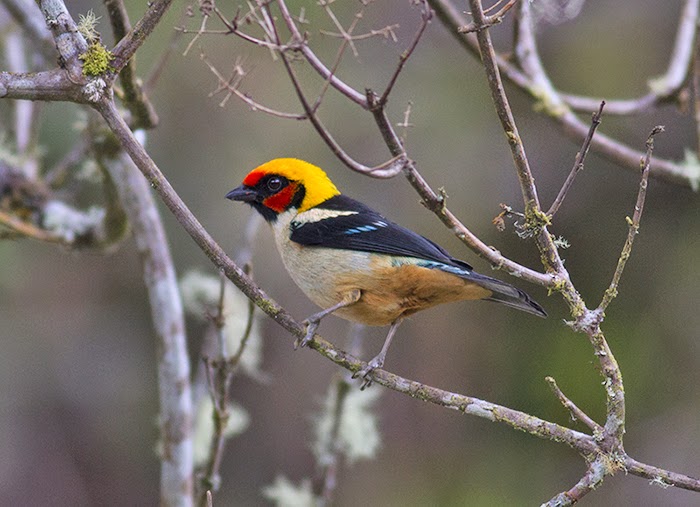
During the remainder of the morning, we picked up more White-capped Tanagers (five this time, compared with seven the day before), a White-collared Jay, a Highland Elaenia (which was a rather lame lifer for me), and enjoyed a flurry of tanagers, dominated by Flame-faced Tanagers, Saffron-crowned Tanagers, and Silvery Tanagers.

After lunch, we decided to try one of the local trails at the lodge, after a brief rest. We headed off down the trail with rain looking imminent. Luckily it stayed away for an hour, which was just enough time to find a White-faced Nunbird, sitting high above a sign with its name on of course, and a super Red-hooded Tanager. Much of the rest of the afternoon was rained off, but, when you have just added a nunbird of this quality to the list, that was fairly easy to take.


More from Abra Patricia and Afluente came the next day, a day which was even better than this one!