Showing posts with label Tanager. Show all posts

28 October 2014

Best Day's Birding; EVER!...Peru (12th Sept.)

This trip to Peru was far from typical; the tour had been condensed from a usual 14-day trip into 11 days of birding. This left a high risk of missing a number of birds, but holiday restrictions for some in the group left no choice in the matter. However, we enjoyed rare, rare luck on this trip, and were so lucky and successful, it felt like a trip that can never be repeated. This day was the perfect example of this...


We awoke at Owlet Lodge, with skies cast in the colour of charcoal, illustrating the imminent threat of rain. For this reason, the three people in the group armed with digital SLRs, myself, Nick and Mark, all left our cameras in our rooms. Rain seemed extremely close, and threatened to curtail birding from the look of the skies above, and so we headed out on the trails near the lodge, with antpittas on our mind. The Abra Patricia area is rich in antpittas, and offered me alone 3 species I had not seen before, all of which are Peruvian endemics. As we had seen one of these the day before (Ochre-fronted), we were now focusing on the others. We started out by trying a spot where Rusty-tinged Antpitta had been heard the day before. It did not take long for a bird to respond, and soon after an antpitta shot across the trail at the speed of the Superhero the Flash! We feared, that would be that, but then, suddenly, another Rusty-tinged Antpitta hopped languidly on to the trail. Our first thoughts were that it would not remain long, but the bird defied usual antpitta behavioural etiquette, and not only remained for several joyful minutes, but even hopped up onto a rock, to make itself prominent and visible to all! At this point three in the group looked rather sheepish at having left our cameras locked safely in our rooms, and unable to capture the moment. Another hour or so on the trail, and we also nailed a third lifer antpitta in this area for me, with a Chestnut Antpitta that hopped out beside my speaker on he trail, and we also managed to track down a Rusty-breasted Antpitta too, to complete a hatrick of antpitta species for the morning. On the way back towards the lodge, with rain beginning to fall, we picked up the fantastically named Oleaginous Hemispingus, and the scarce Olive Flycatcher. By the time we reached the lodge, the threat of heavy rain, had turned into real, heavy rain. Knowing our birding in this area was now curtailed, we decided to head down to lower elevations along the road below the lodge; we had seen nearly all of our targets at the upper altitudes, and also by dropping lower, we hoped that we would move below the main rain belt....

However, when we arrived at Afluente, a famed birding spot, that is actually nothing more than a pull out by a tyre shop, the rain was very much still in evidence, and we were quickly forced back into the van for shelter. It soon became clear no matter how much we complained, prayed, and sat frustrated in the van, that the rain was here to stay for a while. There was nothing left to do than take advantage of the rain break, and take a long nap in the van! Which we did. After over an hour of birding being frozen out Nick awoke us with the news that the rain had nearly stopped, and so we left the vehicle promptly fearing there would not be too many breaks in the rain during the day, thus keen to take full advantage when there were. What followed was one of the busiest and most thrilling birding sessions I have ever experienced in the Andes. The first sign of a flock coming into the area was a Versicolored Barbet making a rapid appearance; then Mark noticed a White-eared Solitaire perched in an open tree! As I missed the solitaire, a much-wanted lifebird, and felt my lack of 'scope did not help, I immediately ran back to the van for my telescope, just a hundred meters or so away. However, this was the period when the floodgates opened for birds, and there was barely time for me to even get my 'scope. As I was reaching the van, a shout went up from Nick "Chestnut-crested Cotinga!" (a long time nemesis of mine), which had chosen to land in the very same tree as the solitaire. Moments later, while still revelling in the cotinga, Mark indicated he had the White-eared Solitaire again, and this time, we all got it. We were taking in both of these striking birds, when Nick, gestured to another beauty located lower down the same tree: a male Scarlet-breasted Fruiteater! It was becoming abundantly clear, we were in for a rare, rare day in the Andes. The next two hours or so were spent admiring a myriad of species that streamed through the trees around us, either as part of an amazingly diverse feeding flock, or visiting a number of trees that were clearly baring fruit in the area. Among the many species seen were" a pair of Lanceolated Monklets, a male Andean Cock-of-the-rock, a lifer Plumbeous-crowned Tyrannulet, the endemic Speckle-chested Piculet, Spotted, Saffron-crowned, Green-and-gold and Blue-necked Tanagers, Blue Dacnis, and a pair of Chestnut-tipped Toucanets. It was thrilling to be surrounded by so many birds, and a flock holding real quality within.


We soon reached lunchtime, but were forced back into the van, after the rain moved in once more, and the flock evaporated into the forest. Another nap was undertaken to cope with the rain break; and with the time approaching mid-afternoon, and the rain still very much in evidence, we opted to head lower still to the town of Aguas Verdes, and check out a new reserve on the edge of town: Bosque de Arena Blanca. This proved an inspired choice as we packed in some final quality birds before dusk forced our dream day to a close. As we walked towards the reserve we noted Lettered Aracaris, the endemic Black-bellied Tanager, and a Amethyst Woodstar in the trees closeby; and at the hummingbird feeders we were treated to both Blue-fronted and Green-fronted Lancebills, and a Many-spotted Hummingbird. While we were there another, large, tour group were there too, and in spite of the din of us all excitedly taking in the great hummers on site, someone spotted a Red-ruffed Fruitcrow in the trees above, which was something I had been dearly hoping to see. Taking a break from the feeders, we were met with mixed success; we got cracking looks at some cracking birds (Blue-naped Chlorophonias, Black-faced Dacnises, Golden-bellied Euphonias, and Paradise Tanagers), but missed a covey of Rufous-breasted Wood-Quails that came in to a gran feeders while we did so. This would have been a great lifer, but after the day we had just had there were no complaints from me; it was truly one of the most thrilling days I had ever experienced in the Andes....


Next up was a hike for yet another new antpitta, and a very, very special one at that...

20 October 2014

You know you make me wanna shout...PERU (11th Sept.)

So, it all started with a bird named Lulu, Lulu's Tody-Flycatcher, a great named bird if ever there as one, which, unfortunately, has been now officially name Johnson's Tody-Flycatcher. I still vehemently vote for Lulu! Much of the day was spent birding in and around the excellent Owlet Lodge in Abra Patricia. This fantastic birder's lodge, set up to preserve the habitat for its famous and rare owlet (Long-whiskered), has a series of trails, which are marked with small signs with bird names slapped upon them. Now I have seen this before at reserves, but rarely do you find the birds beside the appropriate sign. But not at this lodge; we picked up Lulu, right beside the sign bearing its name; this is the way birding should be. 


We then left the lodge and birded along the road below the lodge for a while, walking along another of their trails much further down the road. We were here to try for a scarce flycatcher, and try our luck with the first of several antpittas we were hoping for in this area. While Nick played for the flycatcher, I tried for the antpitta. While we worked on these, we nailed down a Bar-winged Wood-Wren that took little persuasion to come in and check us out. Not long after Nick's target responded from a swathe of bamboo: Cinnamon-breasted Tody-Tyrant, and it did not take long before we saw a pair of these spritely birds. Then. a shiver went up my spine; behind us an Ochre-fronted Antpitta called back rather belatedly. We quickly backtracked and could hear it calling close, it felt like we should be able to see it, but no amount of scanning could track it down. I nervously pressed play on my I-Pod, keeping the volume down, and instantly, it popped up onto an open branch! Amazingly, it lingered there, so we could approach closer and train our cameras on it at length. It was a very special antpitta sightings indeed. 


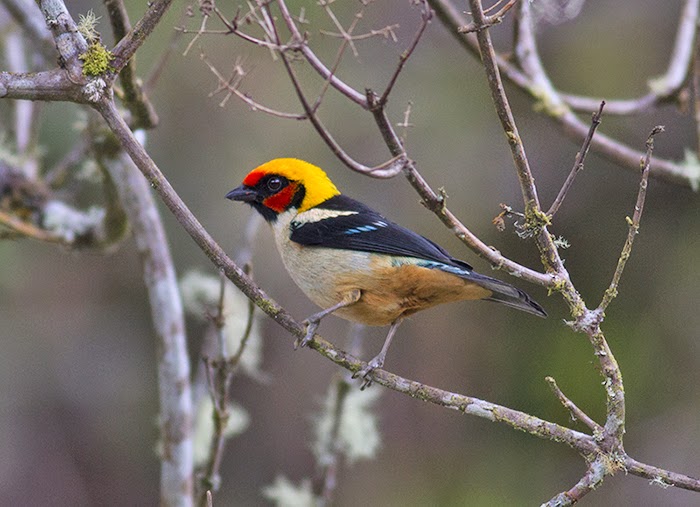
During the remainder of the morning, we picked up more White-capped Tanagers (five this time, compared with seven the day before), a White-collared Jay, a Highland Elaenia (which was a rather lame lifer for me), and enjoyed a flurry of tanagers, dominated by Flame-faced Tanagers, Saffron-crowned Tanagers, and Silvery Tanagers.

After lunch, we decided to try one of the local trails at the lodge, after a brief rest. We headed off down the trail with rain looking imminent. Luckily it stayed away for an hour, which was just enough time to find a White-faced Nunbird, sitting high above a sign with its name on of course, and a super Red-hooded Tanager. Much of the rest of the afternoon was rained off, but, when you have just added a nunbird of this quality to the list, that was fairly easy to take.


More from Abra Patricia and Afluente came the next day, a day which was even better than this one!

15 October 2014

The "other" Snowcap...PERU (10th Sept.)


After our mega day in the foothills and our late night with a few large spectacular owls, you'd think we'd be happy for a lie in. But if you think that you do not know birders; some of us (me included) are a headstrong group of obsessives, who'll stop at nothing for the next bird (more or less); thus, next morning, we ate breakfast pre-dawn and headed straight out in the field. Our first clear target of the day was an interesting thrush; not so much interesting in appearance for, in truth, it is rather dull, coloured in drab olive tones, but more for the story behind it... This turdus thrush was first collected in 1961, and in spite of a different coloured bill (yellowish-green) and a different-coloured tail (grey), from "normal" dark-billed, rufous-tailed, Hauxwell's Thrushes, the specimen was considered as a Hauxwell's all the same. In 2007 the excellent field guide "Birds of Peru" was produced, and in there, clear as day, on plate 256 are two, quite different, illustrations of Hauxwell's Thrush; one depicted with an olive bill, yellowish eye ring, and greyish tail, labelled as a "gray-tailed morph", and another with a more rufous body and tail colour, lacking the pale eye ring, and with a dark bill. They are as different as some of the other species of thrushes in this section. To be fair, one of the co-authors of this brilliant field guide (one of my favourite guides), and original collector of the 1961 specimen, legendary ornithologist John P. O'Neill, in this guide, if you delve into the text, lie the immortal words "probably a separate species". Then from 2003 and later, due to the field skills of Barry Walker and B. J. O'Shea, and working with Dan Lane, Brett Whitney and others, strange thrush vocalisations, led to the final lightbulb moment; this strange, pale-billed, grey-tailed, "morph" of Hauxwell's Thrush sounded quite different from that species after all; a new thrush was born, the so-called Varzea Thrush. After a confusing 50 years in a dusty specimen draw, in a 2011 paper, that 1961 thrush finally got a name, and a rightful identity all of its own (paper here). I am not in any way mocking the people behind this; I have not described a single species after all, and am in awe of scientists of this creed, but it does make for an interesting story. So back to Peru in September; it turns out that the wonderful Waqanki Lodge, is one of the better places to try and track down this enigmatic thrush. The reason for this? An individual regularly feeds on the ground very close to the lodge; or so we were told. Our afternoon search the day before came up empty, although we did hear some intriguing calls, which were clearly coming from a near Varzea Thrush. Thus, after a slightly later than usual, dawn-time, breakfast, we set out in search of this turdus just a few minutes walk away. Our first scout of the area, revealed no thrushes feeding on the ground, and a possible Varzea Thrush sitting completely backlit in a tree, which we had to let go, with no clear ID features being seen. We walked back over the same areas, and Carlos quickly gestured to a thrush feeding on the ground: pale bill, we had it VARZEA THRUSH!


Some final birding around Waqanki that morning (when we refrained from our super-hike activities of the day before, having already bagged the antwren, and in need of a little easier birding). In the open areas we tracked down a pair of nesting Blue-winged Parrotlets, and both Stripe-necked and Pearly-vented Tody-Tyrants. Returning deeper into the forest again, passing canopy flocks held Yellow-bellied Tanager and Purple Honeycreeper, and we got cracking looks at Wing-barred Piprites, a rather handsome, and vociferous, manakin species. Once again (as the day before) we were serenaded by a Chestnut-throated Spinetail, but could not drag it into view, as it called from a thick tangle below us. Mark and I had had enough of this bird, and found a way into the valley bottom, working our way right into its favoured thicket as we did so. Murphy's Law of course ensured that by the time we made it into our idyllic position, the spinetail had fallen silent! We waited, and waited, and then suddenly it returned our playback, and then suddenly appeared on the ground, crawling around more like a tapaculo than a spinetail, just eight feet away! We then packed up and prepared to leave for the cloudforests of Abra Patricia. The beauty of this area is that the route up to those cloudforests is largely forested, meaning a range of altitudes can be covered. Before we rose up in elevation though, we dropped down the road a few bends, parked up by a bridge crossing a deep, dark cavern, and admired some 47 Oilbirds roosting underneath.


Working our way up towards the enticingly sounding "Owlet Lodge", activity was generally on the low side, with the sun beating down, and clouds few and far between (a death knell for bird activity in the Andes). Finally, we arrived at a spot for some "Andean Royalty", jumped out of the van, and walked straight on to the scarce Rufous-tailed Tyrant and the fancy Flame-faced Tanager. However, the Royal Sunagel, our primary avian target, was nowhere to be seen. We moved further up the road, with the aim of trying another spot. However, our focus was quickly switched when the harsh, jay-like cries, of a group of White-capped Tanagers reached our ears. One of the group, Rick, had missed this bird in southern Ecuador, and has a tanager fetish; we simply had to find them. While Nick scouted for the sunangel, I tried calling in the tanagers. They fell silent, when Nick returned with his significantly louder speaker; he cranked up the volume, pressed play, and we watched as seven of these gorgeous tanagers sailed in and landed alongside us. These are big boisterous tanagers, which feel more like jays than tanagers, (they sound so similar to jays, they can cause you to question which it is you have heard). 


After spending over a quarter of an hour with the "other Snowcap" (i.e. the tanagers), we climbed a small hill, with some interesting looking flowers below. Nick pressed play again, when a deep blue hummingbird darted in: Royal Sunangel! We'd barely started breathing following the splendid site of the male sunangel, when a pair of Blue-browed Tanagers suddenly appeared beside us too. The afternoon was turning into a bit of a classic, but there was little of it remaining, so we headed straight for Owlet Lodge, our fantastic lodging for the next three nights. We checked in, (or rather Nick checked us in while we feasted on hummingbirds at the feeders). The feeders were buzzing, and I quickly found my main target, a lifer Emerald-bellied Puffleg, which was backed up at the feeders by Long-tailed Sylph, Sword-billed Hummingbird, White-bellied Woodstar, Bronzy and Collared Incas, Fawn-breasted Brilliant, Chestnut-breasted Coronet, Green Violet-ear, and Booted Racket-tail.


Dusk was approaching, which could only mean one thing: O-W-L-I-N-G! We had already enjoyed rare success with this, but we were not in a supreme area for owls, and the haunt of the enigmatic Long-whiskered Owlet. As it got dark, the image of this owl preyed on our minds...