Showing posts with label Borneo. Show all posts

15 August 2016

John Whitehead the Tormentor….BORNEO (5 & 6 July)

After an amazing time in the lowlands, our attentions switched to the highlands of Sabah, and we headed in the direction of Borneos largest peak, Mount Kinabalu, in the Crocker Range. The first of these days was spent at Tambunan, while the second saw us right on the flanks of the mighty mountain of Kinabalu itself. I have to admit, my favourite Borneo site is in the lowlands, (Danum Valley), as I am as big a fan of the mammals as I am the birds, and that is also where the pittas are found, one of the great bird families of the world, and one for which Borneo is a hotspot. However, the highlands have their own appeal, and for birders with an entirely avian slant, this is where they wish to be, for this is where the highest number of Borneos endemic birds occur.

In particular, there are a trio of species all named after an English explorer, John Whitehead, who conducted surveys in Southeast Asia in the late 1900s, which led him to discover the enormous  Monkey-eating Philippine Eagle in those islands, and the spectacular Whiteheads Broadbill on the island of Borneo. Later, two further species were named to commemorate John Whitehead, which have now become famous amongst visiting birders looking for key endemics: Whiteheads Spiderhunter and Whiteheads Trogon. They have become famous, variously named as the Whiteheads Trio, or The Whiteheads Three, because they are striking and beautiful birds, but also difficult to find; it is entirely possible to miss all three of them. Therefore, as a professional bird tour leader these are a set of quintessential pressure birds.

So we started out at Tambunan, for our endemic Gold Rush as it were, when a surge of endemics was to be expected on our first day in the highlands. In the top of my mind was of course this triumvirate of endemics. To illustrate how difficult they can be, we arrived at Tambunan at dawn, arguably the best place for the Whiteheads Spiderhunter, although it took us until well after lunch to actually see it. Thankfully, we traced it to a flowering vine, where it sat preening, with our scope lined on it, for five whole minutes. Curiously, this same vine also attracted another endemic spiderhunter, with a Bornean Spiderhunter frequenting the same tangle, and causing some notable false alarms prior to the arrival of "Sir" Whitehead!

In our first two days in Borneos highlands, we enjoyed the usual sudden stream of endemic birds and recorded 25 of these key species! At Tambunan, the Barbet Capital of the Highlands, we quickly scored Mountain, then Bornean, then Golden-naped Barbets, completing the five endemic barbets of Borneo (we also saw another Brown Barbet, a new Bornean endemic, following a recent split). Tambunan opened up the wound of endemics that bled out steadily on our first mountain day, with regulars like Chestnut-hooded Laughingthrush, Chestnut-crested Yuhina, Bornean Leafbird, Bornean Bulbul, and Bornean Treepie standing alongside other rarer ones, like Pygmy White-eye and Bornean Forktail. Non-endemics in this first Crocker Range site also included the vivid red Temmincks Sunbird, the subdued Sunda Cuckooshrike, a very cooperative Dark Hawk-Cuckoo (just recently split from Large Hawk-Cuckoo in the latest, August 2016 updates to the Cornell/Clements list); and a fine male Orange-breasted Trogon.
  
Our first morning on Mount Kinabalu, opened with our usual dawntime slow drive up the road, hoping for birds feeding on the road, emboldened to feed in the open in the  half-light; this paid off when we had prolonged views of both Orange-headed Thrush, and the endemic Bornean Whistling-Thrush. Our good form continued when we entered a forest trail, quickly saw a Crimson-headed Partridge, which was shortly after followed by the other of the endemic brace of partridges on the mountain with Red-breasted Partridge too. This all would have been fine and dandy alone, but then, just moments after the second partridge scuttled by, a bright green bird flew up into a tree nearby, and there is no other bird that boasts this iridescent green on the mountain; there just hours into our first morning on the mountain was a Whiteheads Broadbill! In the end we realized there were 3 of them, which soon enough melted back into the forest and were gone, but not before all of got to see them. 

The rest of the day was overshadowed by this bird, but we did get cracking looks at Mountain Wren-Babblers, one of which approached to within 10 feet, and watched an a amazing flock with Bornean Green Magpies and Bare-headed Laughingthrush within it; and also made time to visit Borneos largest flower Rafflesia keithii. This massive flower measured 78cm across, and flowers for just 5-day, and unpredictable, periods. We were lucky to observe it on its second day, before the fourth day that generally sees the flower blacken and start to wither.
 

Having opened with such a stellar two days in the highlands, it was all set for crawl to the finish line, with only a small, discrete set of endemics left to find. Of course, one of the remaining ones to find boar the name of that famed 19th Century naturalist (the tormentor), Whiteheads Trogon

(Big thanks to Chris Sloan for the broadbill photo shown here, and to Michael Todd for getting us those memorable looks at the Whitehead's Spiderhunter!)

10 August 2016

Monkey Business….BORNEO (3 July)

This day was spent within the Sukau area of the Kinabatangan Wildlife Sanctuary. This was not one of the standout days of the tour for birds, with nothing spectacular seen. However, for me birding in Borneo is not only about birds, in spite of the implication. Borneo is a virtual treasure trove of wildlife, and the Kinabatangan area illustrates this well; it is home to an incredible 10 primate species, something that few other places in the World can lay claim to. Indeed, when I first planned on visiting the island of Borneo in 2001, my primary motivation was simian; I desperately wanted to see The Red Ape, or orangutan. Likewise, some of the group who were with me on this latest journey through Sabah, were also strongly driven to come to Borneo with the promise of seeing that odd Great Ape. And so on this day, non-avian wildlife took centre stage. It turned out to be one of the more popular days of the trip, as we enjoyed some cracking looks at many animals, which led to this being the single best day for photography on the entire tour. Borneo is generally, a challenging place for the nature photographer, with difficult light conditions in the tall, verdant, dipterocarp forests. However, Sukau is the one big exception to this, and arguably offers the best photography opportunities on the island.
We spent a relaxing day covering several areas around Sukau by canoe, and once again enjoying a comprehensive field breakfast within the boat, including a fine cup of Sabah Tea on the water! Our morning along the Menanggol River was largely uneventful, aside from some perched Long-tailed Parakeets (more usually fleetingly seen darting overhead); a striking Scarlet-backed Flowerpecker (a vastly underrated Bornean bird in my book); and some close ups of a Stork-billed Kingfisher. A Mangrove Cat-Snake expertly found coiled around a tree by our boatman was another highlight, as was a North Borneo Gibbon lounging in a tree with its Stretch Armstrong upper limbs extended impressively out on either side; (see Stretch Armstong here for the idea!). Gail however stole the morning, when she found the very erratic Jambu Fruit-Dove in a fruiting tree back in our lodge, which it was sharing with six different bulbul species. A few of us smooched around the back of the lodge for a short time before lunch, and were rewarded with point blank views of a gorgeous iridescent male Van Hasselts Sunbird.
In the afternoon it was time for the primates to take centre stage; by the close of the day we had seen 6 different primate species, (and we missed an easy one damn it!). During the afternoon we drifted beneath a giant fruiting fig tree, which was alive with the sound of Blue-eared Barbets, a sound that other frugivorous animals know well and are often drawn to for the promise of fruit at the other end. And so it also emerged on this day too; as we watched the frenzied activity of the leaf-coloured barbets picking off the ripe figs, a large movement caught our attention from the base of the same tall canopy. Soon after, a merlot-coloured arm materialized out from the foliage, revealing itself to be none other than a Bornean Orangutan! We had already seen two of these animals previously, but while our appetite for them had undoubtedly been whetted, it had not been fully satiated. This all changed when a young baby orangutan removed itself from its mothers chest and dangled on its own in full view of a gaggle of excited people gently drifting in a canoe below! 
Once The Red Ape had moved off, (with its offspring now attached once more), we continued along the forest-lined creek, soon bumping into a troop of mischievous looking Southern Pig-tailed Macaques. However, the group were still musing how it was, we were still missing a truly satisfying encounter with another of Borneos celebrity primates, the spectacularly peculiar Proboscis Monkey. In particular, we were still lacking a truly gratifying experience with a bulbous-nosed male of the species. With this in mind, we returned to the main Kinabatangan River, whose gigantic girth is reminiscent of some of the larger tributaries of the mighty Amazon in South America. 
While this final afternoon appeared to be slipping out of reach, with little daylight left to find our final targets, we still managed to find three different male Proboscis Monkeys in this final Sukau "curtain call". The third time really was lucky, as this ultimate proboscis posed at full stretch above us. With 5 primates for the day, we tried for a new monkey in the last knockings of daytime, and remarkably our local guide Remy duly found it, a solitary Silvered Langur preparing to roost along the riverbank. 
The final die cast of the day was a great long look, at the Technicolor Wrinkled Hornbill, sitting by the channel bathed in late afternoon sunlight; (one of five hornbill species for the day). As you may be able to tell, Borneo has cast a long-standing spell over me, and Sukau is surely one of its greatest ecotourism assets! Mammals continued into the night, when (yet another) long duel with one of the local Oriental Bay Owls ended, again, with no owl, but did see us observe a new mammal for the trip in the form of an Island Palm Civet, and yielded another Bornean Colugo, this time viewed from a boat.

23 July 2016

Back to Borneo...26 JUNE


This was a strange start to a Borneo tour; the night before (somewhere near 1am), I arrived back at our Kota Kinabalu hotel having picked up the group from their long flight from the US (via Korea). Just hours later-at just after 6am, we were back in the same airport, a little weary, but heading to one of my all time favourite places to stay, and to bird...Borneo Rainforest Lodge in the Danum Valley Conservation Area. While I had at least had a a few days to recover from the long journey time to Borneo, all of the group had not. In spite of a complete lack of rest time, the group were in good spirits, living on the adrenaline of where they were going, one of the most exciting places to bird in all of Asia.


We winged our way from one side of the Malaysian state of Sabah to the other, arriving in the eastern city of Lahad Datu. A brief stop at the Borneo Rainforest Lodge office in this small town-come-city, got us signed in, but also got us a few quick birds like Plain-throated (Brown-throated) Sunbird and Pink-necked Green Pigeon, to kick off our bird list. Soon after, keen to hit the road, and get into the rainforest, where the greatest bird diversity lies, we were lined up in 3 comfortable pick up trucks-connected by radio-for the journey in. I had fired up the group, and tried to keep them from nodding off from jet lag, with stories of past trips into the lodge, which had yielded elephants and orangutan. Well, we had none of these, but the trip in was no less eventful, with a great set of birds. Our first hornbill was Bushy-crested Hornbill, and amazingly by the time we had reached the lodge we had racked up 6 species of this family. A designated stop-thanks to a tip off from Scott Watson, who had been in the area before me-was by a large blooming tree that was packed full of nectar-eating birds, which even held a lifer for me in their midsts-Scarlet-breasted Flowerpecker, found by Chris and some others shortly after our arrival. The same extended stop also produced our first trogon-Scarlet-rumped Trogon, which glowed red from the dark forest understorey. Further along the road came Changeable Hawk-Eagle-found by Shannon, and an animated party of 4 Great Slaty Woodpeckers. At 50 cm long, this is the largest extant woodpecker in the world, being as large as a female Cooper's Hawk from North America!


Soon after a shock White-crowned Hornbill-found by one of the lodge drivers-we arrived at the lodge and were enjoying the luxury of the place, with a full buffet spread for our lunchtime arrival. Over lunch we cemented an endemic bird on our list, with Yellow-rumped Flowerpecker in the garden. After a rest,  and meeting with our superb lodge bird guide-Azmil-we hit the forest, which was often frustrating and quiet, but early success came at a stakeout for Grey-chested Jungle-Flycatcher, and then, better still, late afternoon produced great views of a pair of Black-crowned Pittas that hopped on to a log and called to us, a stunning endemic bird.


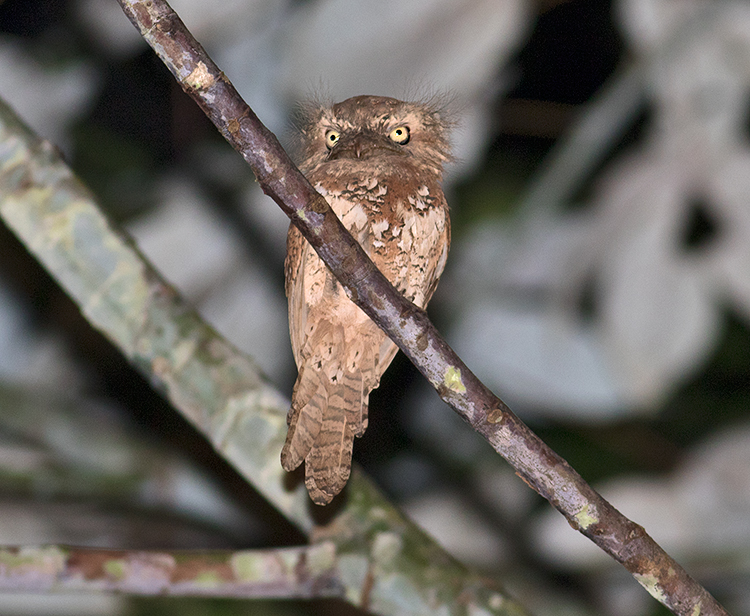
The sheer number of birds heading our way kept the group running on adrenaline alone, and amazingly all agreed to a private night drive to search for key nightbirds and animals too, after dinner at 8:30pm. This lasted about 90 minutes. People would have probably wilted sooner, but the animals and birds came so quick and fast, everyone's attentions were gripped. Not long out of the lodge a Bornean Colugo was found clasped to the side of a large dipterocarp tree; which was quickly followed by a Malay Civet trotting across a lawn nearby. The large and ugly Bearded Pig was spotted near the staff quarters, before we racked up Thomas's Flying-Squirrel as we made our way back along the entrance road to the lodge. After a longer gap, we added a pair of spectacular Barred Eagle-Owls hanging around a small set of buildings, where lights attracted both moths and these owls. On the way back to the lodge, by which time the group was mostly asleep, we added one final bird in the form of a Blyth's Frogmouth, complete with long whiskers jutting out from its cheeks, and an enormous bug clasped in its beak! A dramatic end to a fantastic first day out of Borneo Rainforest Lodge.