25 October 2017

Costa Rica Bird Challenge: Day 3, (14 Oct 2017)

Raptors Galore, and Owl provides opening gambit at Rancho…
Today, we continued the challenge by staying within the Caribbean lowlands and foothills. Initially, we walked around the property of Selva Bananito Lodge, with a 4am start for night birds. Unfortunately, all this produced was the same Great Potoo we had crossed two rivers for, and sweated for the night before, now propping itself just above the lodge, and calling regularly ensuring every team had it by breakfast! A calling Central American Pygmy-Owl, a curiously difficult bird throughout it wide range, was what we were really hoping for, and, in spite of the bird tooting away above us at close range, we simply could not see it in the half light of dawn. Still, a heard counted, and it made it on to the challenge list. The brevity of the walk around the property, unsurprisingly provided little new (as we did not have timer to reach the richer primary forest), aside from a White-winged Becard, and the tragic news that another team had photographed a lifebird for me in a tree we had staked out for it too to add to the anguish: Red-fronted Parrotlet, for which this must be one of the best sites in the country.
Next stop was Kekoldi Hawk Watch, which was superb. From the tower, we observed thousands of raptors making their way south for thee, mostly Broad-winged Hawks, but also Mississippi Kites, Merlins, Peregrines, a single Red-tailed Hawk, a handful of Swainson’s Hawks too, and even a few late moving Swallow-tailed Kites, one of the most elegant of all the American raptors. We also got Yellow-billed Cuckoo, and several migrant warblers from there too, while standing above the level of the surrounding rainforest. 

We headed down from the tower, snaking our way down through the rainforest and cocoa plantations as we did so, picking up an absurdly tame Double-toothed Kite, a boisterous group of Purple-throated Fruicrows, White-whiskered Puffbird, Checker-throated Antwren, and Black-striped Woodcreeper. The next stop was a treat, and involved no birds whatsoever, as we were treated to a lunch in Puerto Viejo, with a Kalypso band playing excellent Caribbean music all the while.

 
Following this, we skirted the coast, seeing more shorebirds, like Greater Yellowlegs, Black-bellied and Wilson’s Plovers, and also found a small number of Brown Noddy feeding close inshore, normally a scarce bird along the Caribbean coast. On the way to our next venue, the highly touted Rancho Naturalista, we spotted a Grey-lined Hawk, a species that has only recently been recorded in this area. 

Our arrival at Rancho was greeted with cocktails, but also a Mottled Owl, which brought dinner to a sudden halt as it posed right beside the lodge, and a late nightwalk led our team to hear a Common Potoo several times, before we retired to bed with fresh images of raptors moving in vast kettles over the rainforest in our minds…
The revered Rancho Naturalista was to provide the avian entertainment for the next day; I could not wait!

#ict #birdwatchingrepublic #ranchonaturalista 


23 October 2017

Costa Rica Bird Challenge: Day 2, (13 Oct 2017)

Snow White Joins the Party…
 
On this day of the “challenge”, or bird race, the day was spent in the Caribbean lowlands and foothills. That is not to say that we hung about much; we had a frantic schedule, and packed in as much as we could in the small space of daylight available (i.e. all 2 hours of it!) We started out by leaving Selva Verde Lodge under cover of darkness, in order to reach one of the most iconic sites in all of Costa Rican birding, (and indeed in all of Central America): OTS La Selva Biological Station, a huge stretch of lowland forest, which excels in providing nothing but excellent birding; (supported very strongly with other wildlife of note too). You never, hear anyone say “it was a bit slow” today at La Selva, this simply does not happen. Rufous-winged Woodpecker fell early on, as if to prove the point, one of the regional endemics of the area. We also got in a few other goodies before breakfast, like a low flying Green Ibis, and even a pair of gargantuan Great Green Macaws overflew us with their deep croaky voices bringing them to our attention. Breakfast was a blur, as we could literally hear the forest calling us from the restaurant, a cacophony of bird noises to tempt our avian-dominated taste buds. We soon met with our local guide, Joel, an expert guide in the true sense, with whom I have toured La Selva with a number of times before; I was stoked to have him again. Birds came thick and fast in our limited time there – we had from dawn to 9am and no more; exhilarating but also tantalizing; normal tours stay at least 2 nights at this research facility, and uber birding hotspot. We sighted, by pure chance 3 Pied Puffbirds sitting idly in an open treetop, got multiple encounters with some raucous Rufous-tailed Jacamars, enjoyed the tufted Chestnut-colored Woodpecker, along with six species of parrots in barely 3 hours, were greatly surprised at the ease of finding a Royal Flycatcher, (a much more difficult bird in the Caribbean than on the Pacific side of the mountains), got at least a pair of Red-throated Ant-Tanagers, a showy brace of Band-tailed Barbthroats, and a handful of wrens (White-breasted Wood, Black-throated, and Band-backed Wrens). The regular firecracker sound of White-collared Manakins were heard in the forest, and one passed by the restaurant too. The high-pitched far-carrying whistles of a Semiplumbeous Hawk were counted on the checklist well before we saw it, but we couldn’t resist going in to see this smart raptor too. As we had gathered from the afternoon before that the pace of raptor migration in Costa Rica was picking up – where some of the largest numbers of birds-of-prey in the Neotropics pass through in the autumn each year -  and this day was no different with Broad-winged Hawks an almost constant sight on the wing in the skies above (an estimated 1500 were seen in those brief hours on site). However, the star bird our brief hours at La Selva, was one of the first that came after breakfast, and was sighted from right beside the restaurant, a spotless, clean white male Snowy Cotinga that exposed itself for a short time in a bare treetop that it shared with a slumbering Green Iguana. We left La Selva with at least 89 species already chalked on our day list…

 
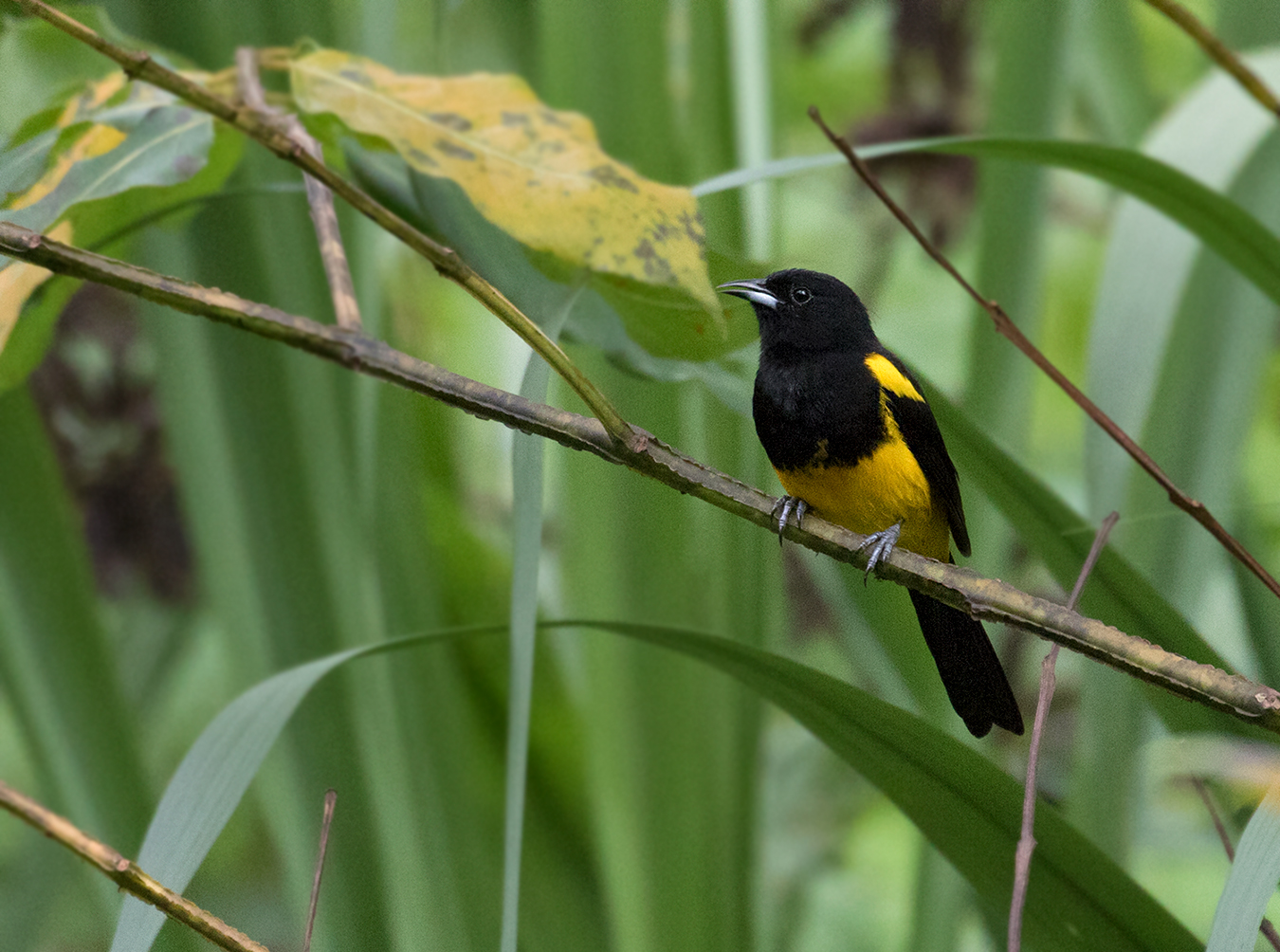
Our reason for cutting short our time at this iconic site was to visit, of course, another hotspot, the Aerial Tram in the Caribbean foothills of Braulio Carrillo National Park, at an elevation of around 500m. Once there (by mid-morning), we were soon in a dangling gondola admiring towering rainforest trees at eye level. It was a wonderful experience with nature, but sadly lacking in birds for the most part, until the majestic form of a King Vulture glided into view above us. For sure, an earlier visit in the day would have yielded more than at this hot and sunny hour, which often prompts the death knell for bird activity in the tropics. We finished with time to spare before lunch on site, so visited the hummingbird feeders, where Snowcap was a conspicuous absentee, but did bring us views of a red-legged Bronze-tailed Plumeleteer plundering the rich nectar resource of lilac verbena flowers. We tried to put some oomph into our time there with a walk in the rainforest, which again was largely silent. But, then, just before lunchtime we hit a flock, a BIG flock, and out of this we pulled several stunning Black-and-yellow Tanagers, (think Prothonotary Warbler, dressed in the body of a tanager), glowing Emerald Tanagers, and Speckled Tanager too. 
We rushed to lunch, for by then were a little tardy having been transfixed by the male Black-and-yellow Tanager, which is the definition of shocking yellow. Following lunch, we had a long drive into a remote lodge within the Caribbean lowlands (Selva Bananito Lodge), connected to the bi-national La Amistad National Park that spreads all the across the Panama border. The lengthy drive was delayed a little to collect the late arriving Jim Lawrence, who due to some incredibly unfortunate timing in Miami, only narrowly missed the flight to be part of the trip from the start. Jim’s first main contribution was to give us our first House Sparrow of the tour, even though he was already committed to another bird group (who were ahead of us), an act of high treason surely! The journey produced an absurdly confiding Ringed Kingfisher that unleashed our cameras, by virtue of its lack of timidity, and the fact that it was sat there with a rather large catfish clasped in its beak. After the long delay in actually getting to Costa Rica, the enthusiastic photographer Jim was feeling much happier following the first proper action for his lens in the tropics. A burst of new birds came along the coast, near the port of Puerto Viejo, where we found Western and Semipalmated Sandpipers, Wilson’s and Semipalmated Plovers, Brown Booby, and Black Tern. By the time we reached the meeting point for our vehicles to transfer us through several rivers to the lodge it was dark, but somehow, this did not stop an American Pygmy-Kingfisher and Yellow-crowned Night-Heron from being seen by people in the front of the vehicle, in the car headlights as we made one of these crossings!
After dinner, and heavy rains in this, the dry season in the Caribbean, the number of people willing to go owling had whittled itself to just 2 of the team, and our constant local guide German; we were joined by one of the lodge staff, who walked us straight to a site for Great Potoo, where one was soon heard, but was devilishly difficult to see. For a time it was merely a pair oif large red eyes shining bvack at the torch from a distant forest canopy, but finally German tracked it down for cracking, long looks. On the way back we also added Common Pauraque to the list, as it sat in the road ahead of us. We retired very tired, but very happy.

22 October 2017

Costa Rica Bird Challenge: Day 1, part II (12 Oct 2017)

Toucans, Tanagers, and TREEFROGS take over…
Having spent the morning in the foothills of the Central Cordillera, our arrival at Selva Verde Lodge also announced our arrival in an extremely bird rich part of the country, the Caribbean lowlands. This was immediately evident, when, following a lunch of traditional rice and beans with more than a splash of Costa Rica’s signature Salsa Lizano, we ran into two different species of trogon (Slaty-tailed and Gartered Trogons), a Black-cowled Oriole, and then walked up to a fruiting tree packed with birds, and a constant hive of activity as birds pulled at the fruits and flew in and out of the tree. 
This was addictive stuff, and we absorbed this feast of birds for a while, which included all three toucan species in the area (Keel-billed and Yellow-throated Toucans, and Collared Aracari), and also held a variety of tanagers, including Scarlet-thighed and Blue Dacnis, and Green and Shining Honeycreepers. Other distractions included Strawberry ("Blue Jeans")  and Green-and-black Poison Dart Frogs on the grounds, and another two-toed sloth (plus baby slothlet this time), for the day.
We also got our first real experience of the vast raptor migration that streams through Central America at this time, as impressive kettles of Broad-winged Hawks overhead held the odd Mississippi Kite among them too too. Our search at the site for one of the lodge’s celebrity birds, the Sunbittern, came up short though, and so we tried another spot later, but again failing to find that, but adding Golden-hooded Tanager, Grey-headed Chachalaca, and also got to watch the acrobatics of some extremely agile Mantled Howler monkeys in the area. The close of the afternoon, not far from the lodge, though, will perhaps best be remembered for a hummingbird fight we witnessed, when a Purple-crowned Fairy seemed to take particular offence to a Long-billed Starthroat calming sitting in a tree overhead. We watched on as the lovely and gentle looking fairy, belied its appearance, by aggressively and repeatedly dive bombing the poor starthroat, which stood firm for a while, before flying off for an easier life!
At night, we searched the lodge property for owls, hearing and seeing none, but being more than rewarded by the sighting of Costa Rica’s most iconic frog species, the Red-eyed Treefrog, which adorns so many book covers, posters and awnings countrywide. The team ended the day with 155 bird species, which was not to be our strongest day of the competition that would come later! I should mention that I had some esteemed company within the team, our local guide was German Rojas, and the other team members were Tim Appleton (the man behind the British Birdfair), Niklas (journalist for Birdlife Sweden's magazine), and Beltran Ceballos Vazquez (a man synonymous with conservation and the famous Cota Donana National Park in Spain).
The next day was set up to a biggie, starting out at the legendary OTS La Selva Biological Station, and then moving on to the Aerial Tram in the foothills of the Caribbean in Braulio Carrillo NP, before departing for another more remote site, Selva Bananito Lodge, located within La Amistad NP, which stretches all the way into Panama!

Costa Rica Bird Challenge: Day 1, part I (12 Oct 2017)

Raptors and Hummingbirds Shine in an Explosive Opening…
Following a brief 5am tea (no coffee for this traditional Englishman) and cookie, we hit the road from downtown San Jose (from the Hotel Aurola Holiday Inn) and headed up into the mountains on the edge of Poas Volcano. Once in the shadow of the volcano, we got straight into some montane species right off the bat, with a fleeting stop at Freddo Fresas, Poasito. The hummingbirds were the main attraction here, with a male Volcano Hummingbird appearing right on cue, competing for our attention with Lesser Violetears (formerly known as Green, before this was spliced into two species recently), Purple-throated Mountain-Gems, and Green-crowned Brilliant. A glowing male Flame-colored Tanager also lent some colour to proceedings. Another short search of some cloudforest led us to a perfectly positioned Hoffman's Two-toed Sloth. 
Another stop beside a stunning, thundering waterfall near the volcano brought us a rush of new species, with some stellar ones among them, such as local specialties like Golden-bellied Flycatcher and Sooty-faced Finch proving remarkably easy at this scenic spot. Better was yet to come though, as, after scoring a very tame Torrent Tyrannulet, an Ornate Hawk-Eagle circled above us in the blue skies overhead. An unexpected, and striking pre-breakfast bird, which made us forget our hunger for just a little while, before this majestic eagle drifted effortlessly out of view.
The next stop was also hummingbird related, but food-related too, as we tucked into a hearty breakfast of traditional Gallo Pinto, while surrounded by birds-mainly hummingbirds at the feeders that included the Coppery-headed Emerald, a country endemic (of which there are only six), and a regional endemic following a visit from one of the local White-bellied Mountain-Gems, a bird that made its lone appearance on this bird race during this breakfast at Cinchona, a bit of a legend amongst birders, and especially bird photographers. It was impossible not to also appreciate the conspicuous beauty of the visiting male Violet Sabrewings, a bold and delightfully common montane hummingbird species in Costa Rica. Silver-throated Tanagers also appeared at the fruit feeders, as did Costa Rica’s shamefully dowdy national bird, Clay-colored Thrush, an appalling choice (considering all the colour on offer among the avian community), in this megadiverse tropical country for this prestigious title.
Following an opening that largely centered around hummingbirds and feeders, we switched to some “real” birding with a visit to Virgen del Socorro, where its most emblematic species, the White Hawk appeared early and calmed nerves quickly. The deserted dirt road allowed us to walk both down and up the valley, steadily adding to our bird list for the day, which included species like Bay-headed Tanager, a couple of Scale-crested Pygmy-Tyrants, a dinky Black-headed Tody-Flycatcher, (akin to a dink frog with its incessant calling nature), a smashing Crimson-collared Tanager, and a steady stream of migratory American warblers (Black-and-white, Tennessee, Blackburnian, Yellow, Canada, Wilson’s, and Chestnut-sided Warblers), showing that they had made it safely through a particularly challenging storm and hurricane season this year, to reach their normal wintering/migratory stopovers in country. 
While not the rarest bird there, a very confiding Lineated Woodpecker found by team member Tim Appleton was my favourite bird of the site, and the photos probably show why…Remarkably, we had only reached the end of the morning at this point! A busy bird afternoon followed our arrival at our next staging point: Selva Verde Lodge. 
NOTE: This challenge was helped and supported by the tourism board of Costa Rica, and Futuropa, among many other contributors, and so I am including the hashtags here to help connect with these organisations:

11 October 2017

A Taste of Tandayapa (Ecuador)...4 Oct 2017


When a journalist come to visit, they rarely have time to stop for too long, so my objective for the day was to give him a taste, a big, bursting mouthful of a taste, of the joys of birding both the lower and upper Tandayapa Valley (which are quite different in the nature of birds found there)...
We started out in darkness, and with headlamps lit, walked into the forest surrounding Tandayapa Bird Lodge, to see what would come into the purpose built forest blind, best visited at the crack of dawn. We might have arrived a little before the crack, but with some patience the birds started showing up. The first one to creep into view was a Streak-capped Treehunter, furtively approaching then dropping down right in front of the hide to pick off some of the moths attracted by the nightlight alongside. The the jangling sound of warblers approacgung could be heard, with Russet-crowned and Three-striped Warblers being typically confiding, if hyper active (think American warblers on speed). Then, one of the other blind regulars turned up, and were as confiding as ever, a pair of Zeledon's Antbirds (formerly known as Immaculate Antbirds before taxonomists spliced that species in two); which appear rather like they are wearing blue eye shadow, as with many antbirds their eyes are surrounded by bare skin (in this case sky blue in colour). Slaty Antwren also betrayed its presence by calling to let us know it was coming, and a female was seen, and then a pair of Uniform Anthshrikes followed the same routine. 
Within 40 minutes of dawn, activity was waning and stomachs were rumbling, so we returned to the lodge for breakfast. Breakfast is not always an easy affair at Tandayapa though, as this is also the peak time for birds to come around the lodge picking off the various insects forms that have come to sit on the lodge and moth sheet during the night. On this day, the procession opened with the star species, a pair of Toucan Barbets, and also included the normally timid Rufous Motmot, giving the performance of a lifetime. Chestnut-capped and White-winged Brushfinches, were also seen on the fringes of the feeding areas. Somehow, in the midst of all of this avian activity, we squeezed in a breakfast, and then set off for the higher cloudforests in the upper Tandayapa Valley. We opened at a traditional spot for the rare Tanager Finch, and less predictably opened our visit there with a pair of Tanager Finches, which were rather easier than usual, and were a mighty first bird on site! The sublime really did turn into the ridiculous, when we next focused on an Ocellated Tapaculo that screamed at us (as they do), from the nearby hillside. I noticed, that rather fortuitously an indistinct trail snaked its way right towards the loud sound of the bird. This bird is very easy to hear (you would need to be near totally deaf to be able to miss the call of this bird within sight of you!), but can be exasperatingly difficult to put binoculars on. And that is exactly how it played out initially with mere glimpses of its polka-dotted form. But then we stepped off trail just a fraction, and the bird was there in full glory for all to see. Our second bird of the morning at this site; we were walking on water!
The rest of the morning up there was understandably not so outstanding, but with some effort, we finally tracked down one of its most famous residents, the endemic Plate-billed Mountain-Toucan, which is daubed in so many colours it could have been designed for a clown (one of the non scary ones). Other finds included Streak-headed Antbird, Turquoise Jay, Masked Trogon, Green-and-black Fruiteater, and  4 more Toucan Barbets in the middle of all this. Finally, lunch beckoned, and we headed down the forested valley in readiness to eat, but were abruptly stopped in our tracks, when we noticed an impressive Barred Hawk staring down at us from above the car, where it lingered for longer than a sharp-eyed raptor would be expected to do...
With rain coming in with force in the afternoon, and having admired the hummingbird feeders at Tandayapa Lodge, we opted for birding undercover elsewhere, at the nearby San Tadeo feeders, which were buzzing with activity, and highlights included Black-chinned Mountain-Tanager, Flame-rumped, Black-capped, Golden-naped and Golden Tanagers. Meanwhile, a study of the hummingbird feeders brought regular interactions with Velvet-purple Coronets, Empress Brilliants, and even led us to a treetop Yellow-throated Toucan, yelping its heart out in the afternoon rain. A taste of Tandayapa finally came to a regretful close.


08 October 2017

Owling by Daylight...(Ecuador) 3 Oct 2017

So, a journalist from BBC Wildlife magazine wanted to sample some of the best birds and sites of northwest Ecuador, and I was fortunate to be nominated for the guide for this one. We started out from Quito, admiring the views of the city below us and the volcano of Cayambe in the background as we made our way to Yanacocha reserve, a 90-minute drive away. The journey there was uneventful, but on site, we saw Scarlet-bellied Mountain-Tanager chomping at the fruit on the feeders, while the various hummingbird feeders that are studded along the trail yielded the living cartoon, Sword-billed Hummingbird, Sapphire-vented and Golden-breasted Pufflegs, feisty burnt-orange Shining Sunbeams, the ginormous Great Sapphirewing, and the conspicuous Buff-winged Starfrontlet. 
Meanwhile, these feeders were regularly raided by Glossy and Masked Flowerpiercers too.  Other notable finds along the trail were a rusty Rufous Antpitta, Grey-browed Brush-Finch (formerly known as Stripe-headed Brush-Finch before a five way split of that species), and a trailside Green-tailed Trainbearer, which remained faithful to one flowering tree. However, our time at Yanacocha will remain remembered for a daytime encounter with a pair of White-throated Screech-Owls, a first for me there!
In the afternoon, after enjoying some excellent local food prepared on site at the reserve by the Jocotoco Foundation workers, we headed for Tandayapa, picking up a peaceful (rare for a lapwing) Andean Lapwing standing in a field. We also scoured the Old Nono-Mindo Road for birds along the way, which came in the form of a bobbing White-capped Dipper, and a squawking gathering of scarlet male Andean Cock-of-the-rocks at a traditional display site, before we reached Tandayapa Bird Lodge in the late afternoon.

 More to come from Tandayapa soon...